VO2 Max by Age: What’s a Good Score, and Can Your Watch Actually Measure It?
VO2 max is the fitness number with the strongest link to long-term health — and the one your watch is least equipped to measure. Here are the ranges by age, and what the figure on your wrist is really doing.

Of all the numbers a wearable shows you, VO2 max has the strongest relationship with long-term health — and it is also the one your watch is least equipped to produce. Both of those things are worth understanding before you take the figure on your wrist too seriously, or dismiss it entirely.
What VO2 max actually is
VO2 max is the maximum rate at which your body can take in and use oxygen during exercise, expressed in millilitres of oxygen per kilogram of body weight per minute (ml/kg/min). It is a ceiling: the point past which working harder no longer increases oxygen consumption.
It depends on how much blood your heart can pump, how well your blood carries oxygen, and how effectively your muscles extract it. That makes it a genuinely whole-system measure of aerobic fitness — which is why exercise physiologists have used it as the benchmark for decades.
VO2 max by age
VO2 max peaks in the late teens to late twenties for most people and declines from there. These are approximate values for healthy adults:
| Age | Men — around average | Men — good | Women — around average | Women — good |
|---|---|---|---|---|
| 20–29 | 44–48 | 50+ | 34–38 | 42+ |
| 30–39 | 40–44 | 47+ | 32–35 | 39+ |
| 40–49 | 36–40 | 44+ | 29–32 | 36+ |
| 50–59 | 32–36 | 40+ | 26–29 | 33+ |
| 60–69 | 28–32 | 36+ | 23–26 | 30+ |
| 70+ | 24–28 | 32+ | 20–23 | 27+ |
All figures in ml/kg/min, approximate and drawn from population reference data. Published norms differ between registries and testing protocols, and a wrist-estimated figure may not be comparable with a lab-measured one at all.
The decline works out at roughly 10% per decade after the peak. But a large share of that is disuse rather than biology — active people decline far more slowly, and the difference between a sedentary and an active 60-year-old is routinely larger than the difference between a sedentary 30-year-old and a sedentary 60-year-old.
What is a good VO2 max?
There is no single good number, because the answer moves with your age and sex. As a rough orientation: a man in his thirties is doing well at 47+ ml/kg/min and a woman in her thirties at 39+, and the threshold drops by roughly 4 points per decade after that. Read your own row in the table above rather than any headline figure — a 45 that is good for a 55-year-old man is unremarkable for a 25-year-old.
Two frames are more useful than the threshold itself:
- Relative to your age and sex. Sitting comfortably above the average column is a good result for most people. Chasing an athlete’s number is not a sensible goal.
- Relative to your own trend. Rising or holding steady as you age is the outcome that matters. A number that is drifting down year on year is the signal worth acting on.
For context on the top end: well-trained endurance athletes commonly sit in the 60s and 70s, and elite cross-country skiers and cyclists have recorded values above 85. Those figures are largely genetic ceiling plus years of training, and they are not a realistic target.
Can your watch actually measure VO2 max?
No. It estimates it, and the distinction is larger than most people assume.
A true VO2 max test happens in a lab. You run or cycle to exhaustion on a graded protocol while wearing a mask that captures every breath, and a metabolic cart measures the oxygen going in and the carbon dioxide coming out. The number is measured directly, from your actual gas exchange.
A watch has no mask and no gas analysis. What it has is your heart rate and your pace. So it infers your VO2 max from how hard your heart works to move you at a given speed — a fitter person runs faster at the same heart rate — and fits that relationship to a model built from lab-tested populations.
This is the same pattern we describe for sleep scores and HRV: the device is not measuring the thing it names, it is inferring it from what a wrist sensor can see. That does not make it worthless. It makes it a trend to watch rather than a number to quote — useful for noticing that your fitness is climbing over a training block, not for comparing yourself with a friend on a different brand of watch.
If the figure on your wrist changed by three points this month, that is worth noticing. If it differs by three points from your friend’s, that is worth ignoring.
Why it matters more than the other numbers
Cardiorespiratory fitness has one of the most consistent relationships with long-term health outcomes in the exercise literature. Large cohort studies have repeatedly found that higher measured fitness is associated with substantially lower all-cause mortality, and that the steepest benefit appears at the bottom of the range — the jump from sedentary to somewhat active is worth far more than the jump from fit to very fit.
Two honest caveats. These are associations drawn from population data, not a promise about any individual. And the strongest evidence comes from lab-measured VO2 max, not from a wrist estimate — so treat your watch’s figure as a rough proxy for a thing that matters, rather than as the thing itself.
How to improve your VO2 max
This is the metric that responds best to deliberate training, and the recipe is well established:
- 1Build an aerobic base. The bulk of your training should be easy enough to hold a conversation — roughly 60–70% of your maximum heart rate, or Zone 2. This is the unglamorous part that most people skip, and it is what raises the ceiling everything else sits on.
- 2Add intervals near your maximum. Three to five minutes at a hard-but-sustainable effort, repeated four to six times with recovery between. Once or twice a week is plenty.
- 3Be consistent for months. Meaningful change takes six to twelve weeks minimum. Nothing here works in a fortnight.
- 4Use large muscle groups. Running, cycling, rowing, swimming and brisk uphill walking all drive it. Resistance training has many benefits, but raising VO2 max is not primarily one of them.
- 5Recover properly. The adaptation happens between sessions. Training hard daily suppresses both your fitness and your HRV.
| Starting point | Realistic gain | Over |
|---|---|---|
| Sedentary | 15–25% | 3–6 months of consistent training |
| Recreationally active | 5–15% | 3–6 months |
| Well trained | 1–5% | A year or more, with difficulty |
Individual response varies widely — a well-documented finding, and a reason not to judge your effort by someone else’s progress.
The pattern is worth noting: the less fit you are, the more there is to gain. If your number looks discouraging, that is precisely the situation in which training pays best.
How we handle it
The Tribe Watch tracks heart rate, sleep and daily activity, and what it syncs is stored under a random ID rather than your name, never sold, and erasable in one tap. We would rather show you a calm picture of your fitness over months than a score to defend each morning — the same reason we don’t package sleep as a daily grade.
And we won’t claim to measure VO2 max in a lab sense, because no wrist device does. If you want a real number, a graded exercise test at a university lab or sports clinic typically costs less than a year of most wearable subscriptions — and it is the only way to get one.
Every wearable estimates this figure. They differ far more in what they do with it — compared here.
So: use the age table for orientation, use your own trend for decisions, and remember that the most valuable thing about VO2 max is not the number. It is that it is one of the few numbers you can genuinely move.
Frequently asked questions
- What is a good VO2 max by age?
- Approximate averages in ml/kg/min run from about 44–48 for men and 34–38 for women in their twenties, down to roughly 24–28 and 20–23 past seventy. A "good" score sits meaningfully above the average for your age and sex — around 50+ for men in their twenties and 42+ for women. Published norms vary by registry and protocol, so treat any chart as orientation.
- What does VO2 max mean?
- VO2 max is the maximum rate at which your body can take in and use oxygen during exercise, measured in millilitres of oxygen per kilogram of body weight per minute. It reflects how much blood your heart can pump, how well your blood carries oxygen, and how effectively your muscles extract it — making it a whole-system measure of aerobic fitness.
- Can a smartwatch measure VO2 max accurately?
- No smartwatch measures it — they estimate. A true test requires a mask and a metabolic cart in a lab measuring your actual gas exchange. A watch infers the figure from how hard your heart works at a given pace. Estimates are best during steady outdoor running on flat ground and degrade with hills, heat, treadmills, intervals and cycling. Use it as a trend, not a number to quote.
- How can I improve my VO2 max?
- Build an aerobic base with mostly easy-effort cardio, add one or two weekly interval sessions of three to five minutes at hard-but-sustainable effort, use large muscle groups such as running, cycling or rowing, stay consistent for at least six to twelve weeks, and recover properly between sessions. Sedentary people can realistically gain 15–25% in three to six months.
- Does VO2 max decline with age?
- Yes — roughly 10% per decade after peaking in the late teens to late twenties. However, a large share of that decline is caused by reduced activity rather than ageing itself, and active people decline considerably more slowly. Much of the typical loss is preventable, and some of it is reversible.
- Why does my watch show a different VO2 max than a lab test?
- Because it is solving a different problem. A lab measures oxygen consumption directly; a watch models it from heart rate and pace, and assumes a typical maximum heart rate for your age. If your true maximum heart rate is unusually high or low, or you train mostly on hills, treadmills or a bike, the estimate can be some way out.
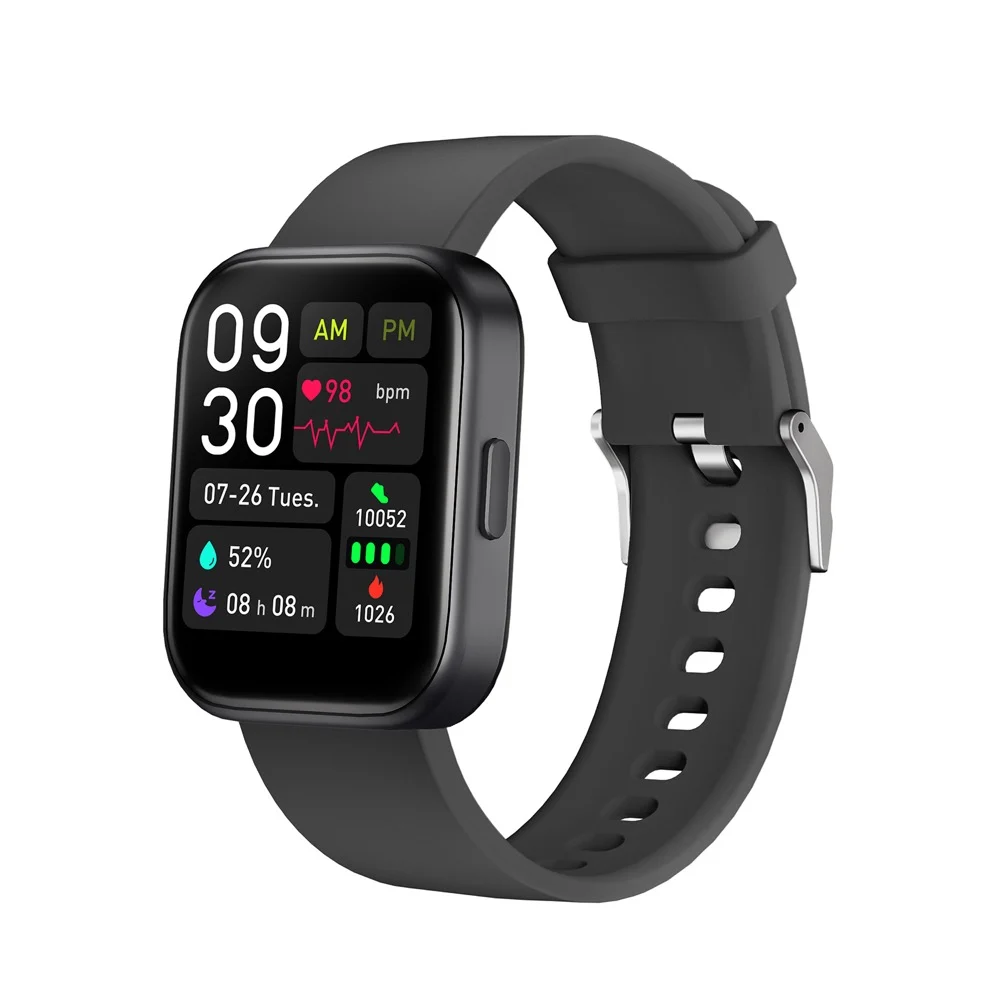
Cardio tracking without the pressure to perform
The Tribe Watch tracks heart rate, sleep and daily activity — a calm picture of your fitness rather than a scoreboard, never sold and yours to delete anytime, with no subscription. $119.99 once, with a one-year warranty and real people on support.
- Never sold, and no ad or analytics trackers in the app
- Locked to your account, saved under a random ID
- Erase everything with one tap, whenever you want
- No subscription for any tracking feature
Private by design. Yours by default.