Does Fitbit Sell Your Data? What Google’s Policy Actually Says
Fitbit’s privacy policy says it never sells your personal information. The question worth asking is who “we” refers to — because the policy is hosted on Google’s support site, and all 79 of Fitbit’s FCC filings name Google LLC as the applicant.

You are asking about Fitbit. The more useful question turns out to be who you are actually dealing with, because the answer changed and most owners never got a meaningful notification about it.
Everything below is quoted from Fitbit’s own privacy policy and from public federal records, read on 17 August 2026.
The short answer
Fitbit’s privacy policy is unambiguous, and we have no reason to doubt it:
“We never sell the personal information of our users.”
Good. Now the harder question: who is "we"?
Who owns Fitbit?
Google. Not as a rumour or a headline from years ago — as a matter of current federal record and live redirects you can check in about two minutes.
- The FCC database. Search Fitbit’s grantee code `XRA` at fcc.gov. All 79 equipment authorisations list the applicant as “Google LLC”, 1600 Amphitheatre Parkway, Mountain View. Not Fitbit, Inc. Every device Fitbit has certified is registered to Google.
- fitbit.com/global/us/about-us now returns a 301 redirect to `support.google.com/fitbit`, which presents itself as the Google Health Help Center.
- fitbit.com/global/us/legal/privacy-policy likewise redirects — to a page on `support.google.com`.
- Fitbit accounts are being migrated to Google Accounts, documented in a help article titled "How to move your Fitbit Account to a Google Account."
So the privacy policy you are reading to reassure yourself about Fitbit is a document served from Google’s website. That is not a gotcha — it is simply the fact that reframes everything after it.
The two words doing the heavy lifting
Here is the sharing clause:
“We transfer information to our corporate affiliates, service providers, and other partners who process it for us.”
"Corporate affiliates." Under most privacy law, moving data inside a corporate group is not a sale — no money changes hands, no third party is involved, and the promise not to sell remains perfectly intact. It is also the single largest category of recipient available, and in Fitbit’s case it means an advertising company with more information about ordinary people than any organisation in history.
Both things are true at once: Fitbit does not sell your data, and your data moves to Google. Those statements are not in tension. That is the part worth sitting with.
And then this sentence
“If you use your Fitbit devices and services with a Google Account, then your data will be handled as described in the Google Privacy Policy.”
Read that alongside the account migration. The protection you are relying on is the Fitbit policy, and the direction of travel is away from it. Once you are on a Google Account, the document governing your resting heart rate, your sleep and your daily movement is not the one quoted at the top of this page — it is Google’s.
The standard clauses, for completeness
| Clause | What it says | What it means |
|---|---|---|
| De-identified sharing | “We may share non-personal information that is aggregated or de-identified so that it cannot reasonably be used to identify an individual.” | Continuous heart rhythms and movement patterns are unusually easy to re-identify — the label is doing more work than it looks. |
| Change of control | “If we are involved in a merger, acquisition, or sale of assets, we will continue to take measures to protect the confidentiality of personal information.” | It promises measures, not that your data stays where it is. In a sale, it goes with the assets. |
Neither is unusual. Almost every wearable policy contains both, as covered in do fitness trackers sell your data and in Oura’s policy, which names AI vendors and employers among its own recipients.
The pattern, once you have seen it twice
Every one of these clauses is legal, disclosed and completely standard. None of them requires anybody to behave badly. And every single one is only possible because an identified record of your body exists on a server you do not control.
A privacy policy is only as durable as the company making it. Whether there is an advertising business behind your data outlasts any single promise.
How the Tribe Watch answers it
| The question | Tribe Watch |
|---|---|
| Who owns the company? | Tribe Watch, independently owned. No parent, no group, no corporate affiliates. |
| Does it have an advertising business? | No — anywhere in the company. We sell watches. |
| Where is your health data stored? | In the cloud (Firebase) under a random ID, kept apart from your name and never sold. |
| Which policy governs it if you change account? | One account, one policy — no parent company to migrate you to. |
| What happens if the company is sold? | No advertising business or broker relationships to inherit — and you can delete everything first. |
| What does it cost to keep access? | Nothing. $119.99 once, every tracking feature forever. |
That is part structure, part promise: how it is built — a random ID kept apart from your name, no ad or analytics SDKs in the app, access locked to your account — alongside the commitment that we don’t sell it and you can delete it yourself anytime.
Fitbit is one of several. The full comparison runs the same five questions across every major brand.
So: no, Fitbit does not sell your data. It transfers it to its corporate affiliate, which is Google, under a policy hosted on Google’s website, and it is moving you onto a Google Account under which Google’s own policy applies. Every word of that is disclosed. Almost nobody reads it.
Frequently asked questions
- Does Fitbit sell your data?
- Fitbit’s privacy policy states: “We never sell the personal information of our users.” There is no evidence to the contrary. The policy does say it transfers information to “corporate affiliates, service providers, and other partners” — and Fitbit’s corporate affiliate is Google. Transferring data inside a corporate group is not a sale, so both statements are true simultaneously.
- Who owns Fitbit?
- Google. All 79 of Fitbit’s FCC equipment authorisations, under grantee code XRA, list the applicant as “Google LLC” of Mountain View, California. Fitbit’s own about page and privacy policy URLs now redirect to support.google.com, which presents as the Google Health Help Center, and Fitbit accounts are being migrated to Google Accounts.
- Is Fitbit owned by Google?
- Yes. It is verifiable from federal records rather than press coverage: every Fitbit equipment authorisation in the FCC database names Google LLC as the applicant, and fitbit.com redirects both its about page and its privacy policy to Google’s support domain.
- Does Google use Fitbit health data for advertising?
- We have found no statement in Fitbit’s privacy policy that health data is used for Google advertising, and we are not going to claim one exists. What the policy does say is that if you use Fitbit with a Google Account, your data is handled as described in the Google Privacy Policy — so that is the document to read, and Google’s primary business is advertising.
- What happens to my Fitbit data if I move to a Google Account?
- Fitbit’s policy states that if you use your Fitbit devices and services with a Google Account, your data will be handled as described in the Google Privacy Policy. Since Fitbit accounts are being migrated to Google Accounts, the document governing your health data changes as part of that move.
- Is there a fitness tracker with no parent company harvesting your data?
- Yes. The Tribe Watch is independently owned — no parent company, no advertising business. Your readings are stored under a random ID kept apart from your name, never sold to advertisers or data brokers, with no trackers in the app, and it costs $119.99 once with no subscription. You can delete your account and all data anytime.
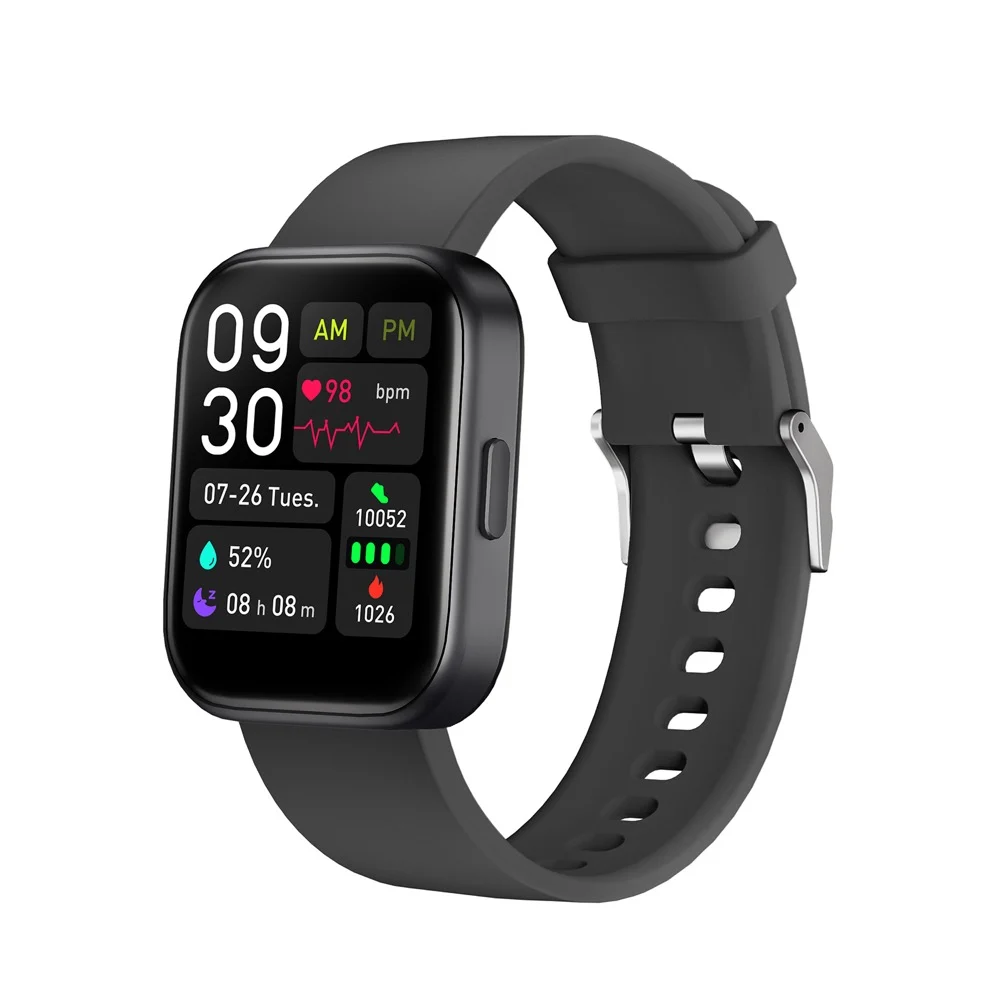
A watch with no parent company to worry about
The Tribe Watch stores your body’s readings under a random ID, kept apart from your name. No corporate affiliates, no advertising business anywhere in the company, and no account to migrate. $119.99 once, no subscription, and one tap erases everything.
- Never sold, and no ad or analytics trackers in the app
- Locked to your account, saved under a random ID
- Erase everything with one tap, whenever you want
- No subscription for any tracking feature
Private by design. Yours by default.