Apple Watch Radiation: What It Actually Emits, and How to Check
Nobody selling you a shielding case will tell you what an Apple Watch actually contains. It is five radio technologies, one of them a cellular modem. Here is how to check it yourself — and what a watch with a single 0.91 mW radio looks like next to it.

If you are searching this, you have probably already found the shielding cases, the stickers and the pendants. What you have not found is anyone willing to say what an Apple Watch actually transmits.
So here is what is inside one, where the numbers come from, how to verify them yourself, and — since we make a competing watch and are not going to pretend otherwise — what a device built to transmit as little as possible looks like beside it.
The short answer
An Apple Watch emits radio-frequency energy — the non-ionising kind. It is the same category of emission as your router, your car key and your wireless earbuds, and it is a different thing entirely from the ionising radiation of X-rays or radioactive material, which carries enough energy per photon to break chemical bonds.
How much it emits depends on which radios are running. And an Apple Watch has more of them than almost anything else you wear.
What is actually inside an Apple Watch
From Apple’s own published specifications for the Series 10, the cellular model contains:
| Radio | What it does |
|---|---|
| LTE and UMTS | Cellular. Lets the watch work without your phone — and transmits at cellular power to do it. |
| Wi-Fi (802.11 b/g/n) | Connects to networks directly. |
| Bluetooth 5.3 | Talks to your phone and headphones. |
| NFC | Contactless payments. |
| Ultra-wideband | Precise location for device-finding features. |
Apple Watch Series 10 technical specifications, checked 17 August 2026. The GPS-only model omits the cellular radio; the rest remain.
That is five radio technologies on one wrist. None of them is unusual for a phone, and that is rather the point — a cellular Apple Watch is a phone you wear, and it transmits like one because it has to.
The heaviest of them is LTE. Ordinary consumer cellular devices sit in a power class specified to transmit at up to 23 dBm — 200 milliwatts. That is a ceiling rather than a constant: cellular radios use adaptive power control and drop well below it when signal is strong, climbing toward it in a basement or a rural notspot.
How that compares with a watch built to stay quiet
The Tribe Watch was built around a different decision: we re-flashed it so it never connects to the original manufacturer’s app or servers, and it talks only to your phone over a short-range Bluetooth link. Once the watch only has to reach the phone in your pocket, it has almost nothing to transmit — so it does not need Wi-Fi, and it certainly does not need a cellular modem.
| Tribe Watch | Apple Watch (cellular) | |
|---|---|---|
| Radios | 1 | 5 |
| Cellular modem | None fitted | LTE + UMTS |
| Wi-Fi | None fitted | Yes |
| Strongest radio | Bluetooth LE | LTE |
| Maximum output | 0.91 mW (measured) | 200 mW (LTE class ceiling) |
| Price | $119.99 once | From several hundred, plus a cellular plan |
Tribe figure is measured conducted output from FCC ID 2ASAU-S90, §5.4.5. The Apple figure is the ceiling for its LTE power class, not a measurement from Apple’s filing — see below.
Be careful with that last comparison, because we want you to trust the rest of the page. Our 0.91 mW is measured. The 200 mW is a class ceiling, not a figure from Apple’s own test report, and it describes a cellular radio rather than a Bluetooth one. The two numbers are not the same kind of number.
What is not in doubt is the hardware. You cannot switch off a radio that was never installed.
That is the difference worth understanding. Airplane mode is a setting — it can be turned back on, changed by an update, or simply forgotten on a night you meant to use it. A watch with no cellular radio in it cannot transmit on cellular under any setting, on any firmware, ever. The same applies to Wi-Fi.
What about SAR?
SAR — specific absorption rate — measures how much RF energy your tissue absorbs, in watts per kilogram. It is a different test from transmit power and it is the figure most often quoted in phone-radiation coverage.
Apple publishes RF exposure information for each Apple Watch model on its regulatory site, and if SAR is what you care about that is where to read it rather than anywhere secondhand.
How to check an Apple Watch yourself
Five minutes, free, and far more reliable than any article — including this one.
- 1Get the FCC ID from the watch: Settings › General › Regulatory. Apple’s grantee code is `BCG`.
- 2Search it at the FCC Equipment Authorization database, `fcc.gov/oet/ea/fccid`. First three or five characters go in Grantee Code, the rest in Product Code.
- 3Open the grant, and read the Equipment Specifications table. Each line is one radio, with its frequency range and output power in watts.
- 4Count the lines. That number tells you more than any single wattage does.
- 5For SAR, go to Apple’s own regulatory pages rather than the FCC grant.
Do the same to us. Our ID is 2ASAU-S90 and it is the reason we can write this page at all — the full breakdown of what we found, including a Fitbit measured at 10.3 mW, is here.
So is it harmful?
We are not going to tell you it is, because that is not established, and a company selling you an alternative is the last source you should accept it from.
International exposure guidelines are built around tissue heating, and consumer wearables operate far below the levels at which measurable heating occurs. Harm below those limits has not been demonstrated. Anyone telling you otherwise while selling a shielding sticker is asking you to buy their conclusion along with their product.
What we will say is that wanting less of something does not require proof of harm. People choose lower-alcohol drinks and quieter appliances without producing a study first. A watch sits against your skin all day and all night, which a phone in your bag does not, and preferring one small radio there to five is a perfectly reasonable thing to want. You are entitled to the numbers that let you choose — which is the part this industry withholds.
What are you actually paying for?
Ask yourself how often you leave the house without your phone. For most people the honest answer is almost never — which means the cellular radio, the single heaviest transmitter on your wrist, is running for a capability you rarely use.
And it is not free. A cellular Apple Watch costs several hundred dollars, then a monthly line on your carrier plan for the rest of the time you own it. You are paying twice — once for the hardware, then every month — to carry a second phone radio against your skin while the first one sits in your pocket.
If what you want is your heart rate, your sleep and your daily activity — tracked simply, never sold to anyone, with the least transmitting the job requires — then those extra four radios are not features you are using. They are just there, transmitting, and you are paying for them every month.
- One radio, Bluetooth Low Energy, measured at 0.91 mW — 0.09% of the FCC limit.
- No cellular modem and no Wi-Fi fitted, so there is nothing to switch off or trust us about.
- Readings stored under a random ID rather than your name, never sold, and erasable in a single tap.
- $119.99 once — no subscription on any tracking feature, ever.
- FCC ID 2ASAU-S90, public, so none of the above depends on believing us.
Radios are one axis. If you are weighing a purchase, the full comparison of what each brand does with your data covers the rest.
So: an Apple Watch emits non-ionising radio energy from five radios, the heaviest rated to 200 mW. Whether that matters to you is your call, and we are not going to make it for you. But you should be able to see the numbers first — and now you know where they live.
Frequently asked questions
- Does the Apple Watch emit radiation?
- Yes — non-ionising radio-frequency energy, the same kind emitted by Wi-Fi routers, Bluetooth headphones and baby monitors. It is not the ionising radiation of X-rays or radioactive material, which carries enough energy per photon to break chemical bonds. A cellular Apple Watch emits from five radio technologies: LTE and UMTS, Wi-Fi, Bluetooth, NFC and ultra-wideband.
- How much radiation does an Apple Watch emit?
- It depends which radio is transmitting. The heaviest is the cellular modem: ordinary consumer LTE devices belong to a power class rated up to 23 dBm, or 200 milliwatts, though adaptive power control keeps them well below that in good signal. For absorbed-energy figures, Apple publishes RF exposure information for each model on its own regulatory pages.
- Is Apple Watch radiation harmful?
- Harm from non-ionising radiation below international exposure limits is not established, and consumer wearables operate far below the levels at which measurable tissue heating occurs. No wearable company — including us — is in a position to settle that question, so treat anyone who claims to be, especially while selling shielding products, with caution.
- What is the SAR of an Apple Watch?
- SAR measures how much RF energy body tissue absorbs, in watts per kilogram, and is a separate test from transmit power. Apple publishes RF exposure information for each Apple Watch model on its regulatory site, which is the source to use rather than any secondhand figure.
- Is it bad to sleep with an Apple Watch on?
- There is no established harm at these exposure levels, so this is a preference rather than a safety question. If you would rather not have a cellular and Wi-Fi capable device against your skin overnight, the options are to enable airplane mode before bed — remembering it is a setting that can be changed or forgotten — or to use a tracker that has no cellular or Wi-Fi hardware fitted in the first place.
- Which smartwatch has the lowest radiation?
- Look it up rather than trusting any brand’s claim. Every device sold in the US has an FCC ID whose grant lists each radio and its output power in watts. Count the radios as well as reading the wattage — a watch with one Bluetooth radio transmits far less over a day than one carrying Bluetooth, Wi-Fi, cellular, NFC and ultra-wideband. For reference, the Tribe Watch measures 0.91 mW on a single Bluetooth radio, under FCC ID 2ASAU-S90.
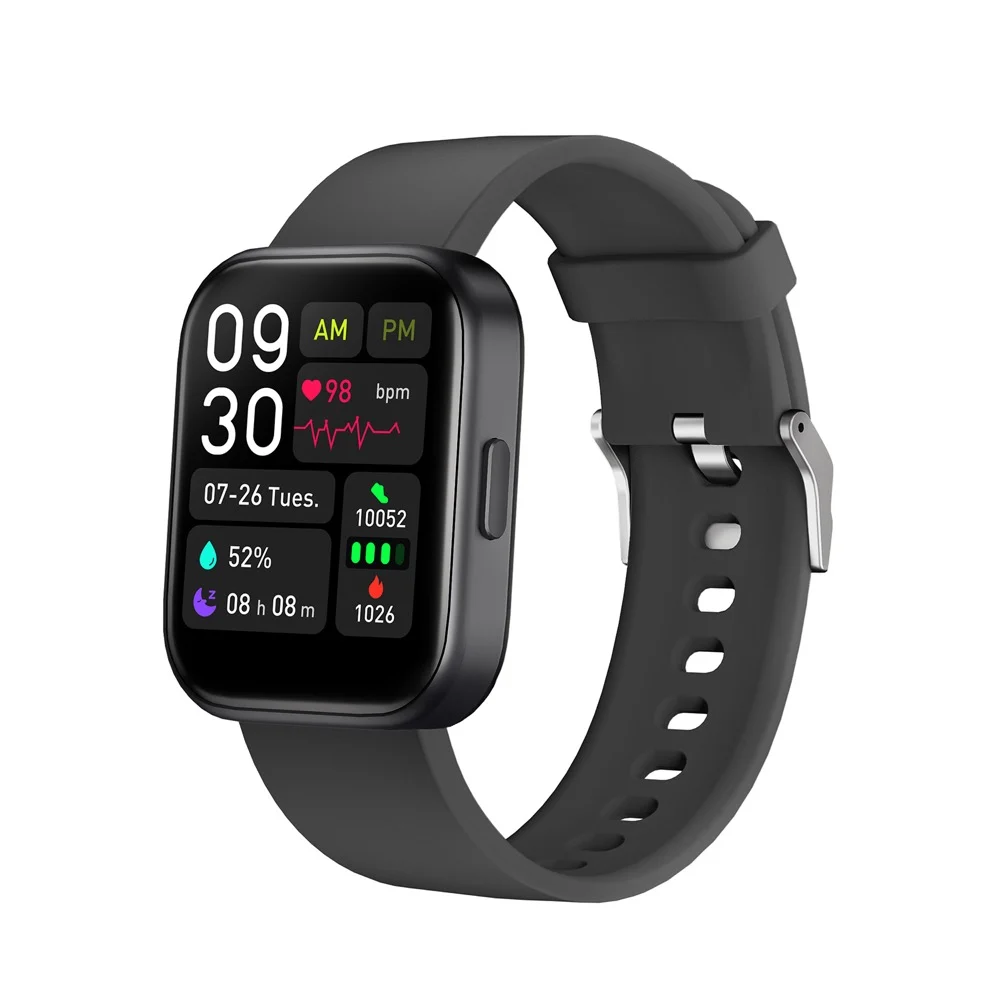
One radio, 0.91 mW, and the filing is public
The Tribe Watch has a single Bluetooth Low Energy radio — no cellular modem, no Wi-Fi, no ultra-wideband. Because it talks only to your phone — we re-flashed it so it never connects to the original manufacturer’s servers — there is almost nothing for it to transmit. FCC ID 2ASAU-S90. $119.99 once, with a one-year warranty.
- Never sold, and no ad or analytics trackers in the app
- Locked to your account, saved under a random ID
- Erase everything with one tap, whenever you want
- No subscription for any tracking feature
Private by design. Yours by default.